Walk down any pharmacy aisle or scroll through social media, and you will see hundreds of products promising a blindingly white smile in days. But when comparing professional in-clinic whitening vs. at-home solutions, what actually removes stubborn stains, and what is simply clever marketing? Understanding the science of tooth enamel and bleaching agents will save you both time and unnecessary tooth sensitivity.
The Quick Answer
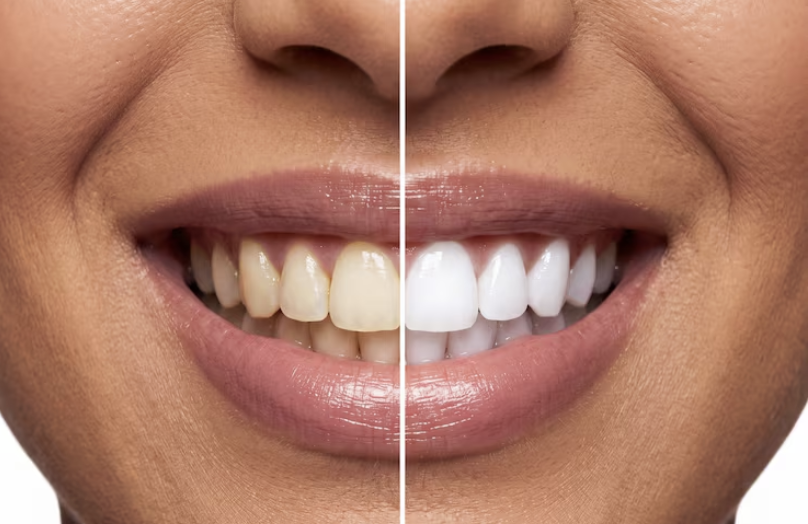
Professional in-clinic whitening uses high-concentration, medical-grade hydrogen peroxide (25%–40%) activated under clinical supervision, lightening teeth by 5 to 8 shades in a single 60-minute session.
At-home whitening relies on lower-concentration carbamide or hydrogen peroxide (3%–15%) requiring daily application over 2 to 4 weeks. Over-the-counter DIY hacks (charcoal, baking soda, LED smartphone lights) largely do not bleach internal stains and can damage enamel.
"Whitening only works on natural enamel by breaking down chromogens inside the dentin. No whitening product, professional or over-the-counter, can change the shade of crowns, veneers, or composite resin fillings."
What Works: Clinically Proven Methods
True tooth whitening relies on an oxidation reaction where peroxide molecules penetrate the porous enamel rods to break apart deep chemical pigment bonds (chromogens) in the underlying dentin.
1. In-Office Professional Whitening (Fastest & Most Predictable)
Administered directly by a dental professional, this treatment delivers the highest potency of active bleaching agents. Before application, the clinician places a protective rubber dam or resin barrier over your gums and soft tissues to prevent chemical burns. High-potency gel is applied in multiple 15-minute cycles, delivering immediate, dramatic shade shifts with minimal soft-tissue irritation.
2. Custom Take-Home Trays (Best for Long-Term Maintenance)
Your dentist takes precision digital scans of your arches to fabricate scalloped, flexible plastic trays tailored to your exact gum margins. You fill these trays with professional-strength carbamide peroxide gel and wear them for 30 to 60 minutes daily (or overnight) for 10 to 14 days. This delivers professional results on your own schedule with superior gel retention and zero gum contact.
3. ADA-Approved Whitening Strips (Decent for Mild Staining)
High-quality commercial strips contain low concentrations of real hydrogen peroxide. While they can gradually lift mild surface stains over several weeks, their flat, generic shape cannot contour around rounded tooth curves or reach deep between teeth, often leaving uneven patches or yellow margins near the gums.
What Doesn’t Work (And What Harms Your Teeth)
The internet is full of viral DIY hacks that promise cheap whitening results. Most either fail clinically or actively destroy your protective enamel:
- Activated Charcoal Powders: Charcoal cannot chemically bleach teeth. It is highly abrasive and acts like sandpaper, scraping away superficial stains along with your protective enamel. As enamel thins, the yellowish dentin underneath shows through, making teeth look darker over time.
- Lemon Juice & Baking Soda: Mixing acidic fruit juices with alkaline abrasives creates an enamel-eroding scrub that demineralizes teeth and accelerates tooth sensitivity and decay risk.
- Oil Pulling (Coconut Oil): While swishing edible oils may support general oral hygiene by reducing bacteria, there is zero scientific evidence that it breaks down internal tooth stains.
- Budget Blue LED Novelty Lights: Inexpensive at-home kits paired with smartphone-powered blue lights are purely aesthetic gimmicks. Unless paired with a professionally formulated photo-reactive catalyst, standard blue LEDs do not accelerate bleaching.
Professional vs. At-Home: Key Differences
- Bleaching Potency: In-clinic treatments utilize 25%–40% hydrogen peroxide; commercial retail strips typically offer only 3%–10% strength.
- Speed of Results: In-office treatments achieve full brightness in a single hour; at-home systems require 14 to 21 consecutive days of consistent compliance.
- Gum Protection: In-office procedures use custom-cured gingival barriers to shield gums entirely; loose OTC trays and strips frequently leak peroxide onto delicate gums, causing chemical blanching and burns.
- Sensitivity Management: Professional treatments incorporate potassium nitrate and amorphous calcium phosphate (ACP) desensitizers to prevent post-treatment nerve zings.
The Honest Reality
Whitening is not a universal solution for every kind of discoloration. Intrinsic gray-brown staining caused by childhood tetracycline antibiotics, dental trauma, or developmental enamel defects will not respond predictably to surface bleaches. In these instances, minimal-prep porcelain veneers or composite bonding are far more effective.
A pre-whitening dental exam ensures your teeth are free of active cavities and gum disease. Applying peroxide over an untreated cavity or leaking filling can penetrate directly into the nerve, triggering severe, acute pain.
Brighten Your Smile Safely
Achieving a whiter smile should never come at the expense of your tooth enamel or gum health. Schedule your professional whitening consultation today to discover the safest, most effective approach for your teeth.